Voluntary
Green Diesel Solutions
Sustainable HVO fuel for road transport decarbonisation. Cut Scope 1 and 3 emissions without operational changes.

From voluntary insetting to mandatory compliance, we help you decarbonise your supply chain and deliver measurable and verified climate impact.



Supply chains are a major source of global emissions, yet reducing them is often slow, complex and expensive. CarbonLeap was founded to change that.

Born from equal parts frustration and optimism, our founders combined decades of experience to create practical, scalable solutions that close the gap between ambition and action. We deliver this through voluntary insetting solutions, which cut emissions directly within supply chains; and compliance solutions, which help businesses meet regulations like FuelEU Maritime, reFuelEU or CBAM.

CarbonLeap makes sustainability actionable, impactful, and rewarding, helping businesses cut transport emissions with transparency and integrity while leading the transition to a net-zero global transport ecosystem.
"We empower businesses to cut transport emissions with transparency, integrity, and proven impact."
Practical solutions to decarbonise your supply chain, reduce Scope 1 & 3 emissions, and meet voluntary and compliance requirements while delivering measurable climate impact.
Sustainable HVO fuel for road transport decarbonisation. Cut Scope 1 and 3 emissions without operational changes.
Practical, scalable solutions to cut Scope 3 emissions without operational changes.
Achieve FuelEU Maritime compliance through pooling strategies and expert guidance to avoid penalties.
Advanced digital platform for secure, transparent and actionable carbon management.
A COMMUNITY FOR SUPPLY CHAIN DECARBONISATION
CLUBLEAP
ClubLeap is a global community helping companies navigate and act on supply chain decarbonisation. We keep you ahead of the curve, help you find direction, and make action possible by bringing companies together.

Information is fragmented, solutions are hard to compare, and rules keep changing. ClubLeap makes it practical and accessible, regardless of your company's size.
Learn • Navigate • Act

We aggregate demand to unlock scale, making zero and near-zero emission transport more affordable and accessible across marine, road, air, and rail.
See how businesses are achieving verified emission reductions with CarbonLeap.
“Insetting solutions as those offered by Carbon Leap and others are needed to kick-start the uptake of low GHG fuels ahead of oncoming regulations. This will drive the necessary innovation in production and use of those fuels by solving the principal agent problem.”
Jasper Faber
Policy advisor sustainable shipping, Ministerie van Infrastructuur en Waterstaat
“CarbonLeap helps us build off the CO2 in a certified way. With that we have an opportunity to distinguish ourselves commercially with customers who are also increasingly looking at sustainable products. If you have your CO2 reduction in order, you will bring in more customers.”

Jeroen De Waaij
Global Sustainability Manager, Meelunie
“Doing more good rather than doing less bad within a value chain.”

World Economic Forum
Characterizing Carbon Insetting
“...tackling the carbon emissions of their suppliers, rather than offsetting their emissions in the controversial voluntary carbon market.”

Patrick Temple-West
Journalist, Financial Times
“While carbon offsetting has a positive impact on the environment, it doesn't reduce the transport sector's carbon footprint. Carbon "insetting" opens a new and very promising pathway to decarbonising the global freight transportation network.”

DHL
How we can decarbonise freight shipping
Latest from our feed

CarbonLeap
What is Book and Claim, and how does it work? Low-carbon fuels aren't yet available on every route, and many companies don't own the trucks or ships that move their products. With Book and Claim, the fuel is used in the transport network wherever it can be delivered, and the emission reduction is recorded in a registry. A company can then claim that reduction for its own transport, even if the fuel wasn't used on its own shipments. Each reduction can only be claimed once. Since SBTi published its Corporate Net-Zero Standard V2.0, this has become a credible way to work towards your target once direct options run out. In this short video, we explain how it works, step by step. Want more explainers like this? Join ClubLeap for webinars, guides and updates on transport decarbonisation. #BookAndClaim #SBTi #Scope3 #TransportDecarbonisation

CarbonLeap
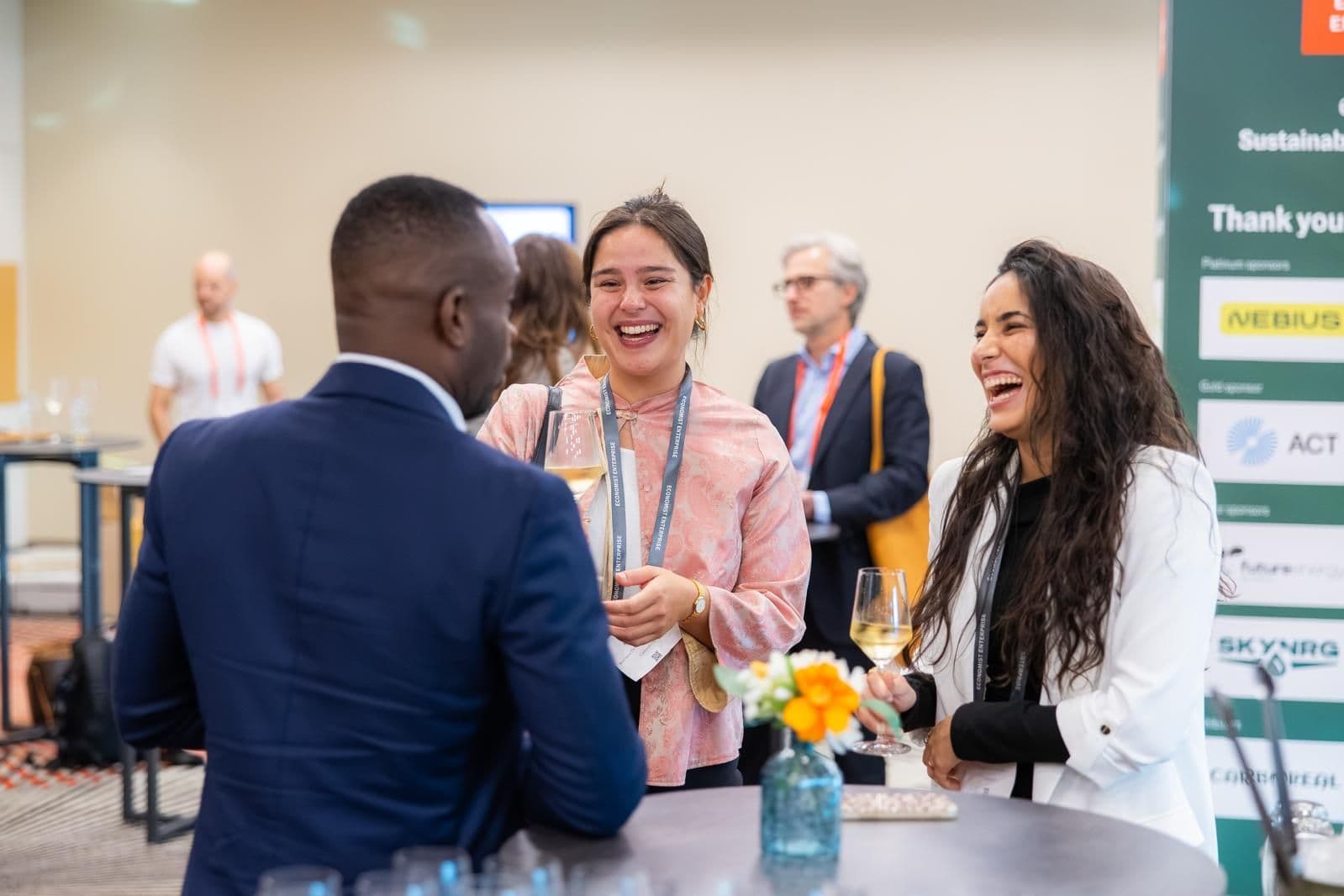
"We know we cannot do it alone." That line sums up what we heard at the Economist's Sustainability Week Europe here in Amsterdam, where we spent yesterday with Lisa Melman and Teresa Gupta. A few years ago, most of the talk at events like this was about targets. This time it was about delivery: where businesses should act first, how to decarbonise complex value chains, and how to put supply chain resilience into practice. Many companies are already pulling direct levers in their own supply chains: optimising routes, improving load factors, shifting modes. We fully support that, and it should always come first. But those operational changes eventually hit a ceiling. At some point the remaining emissions come down to the fuel itself. Moving past that ceiling means bringing more people to the table. Your suppliers, who run the trucks, ships and planes. Your procurement team, who set the terms and budgets. And your customers, who increasingly expect lower emissions in what they buy. Which raises the question that kept coming back: who is paying? At CarbonLeap, our answer is that sustainability is a shared responsibility. When cargo owners, forwarders and carriers co-invest in the same supply chain, the cost per company drops and the fuel switch actually happens. Each party pays its share and gets a verified reduction it can report. That's what Book and Claim makes possible, and it was encouraging to hear more companies looking at it. Thanks Economist Enterprise - Events for a well-run event, and to everyone who came over to talk to us. Several of those conversations will definitely continue.
CarbonLeap
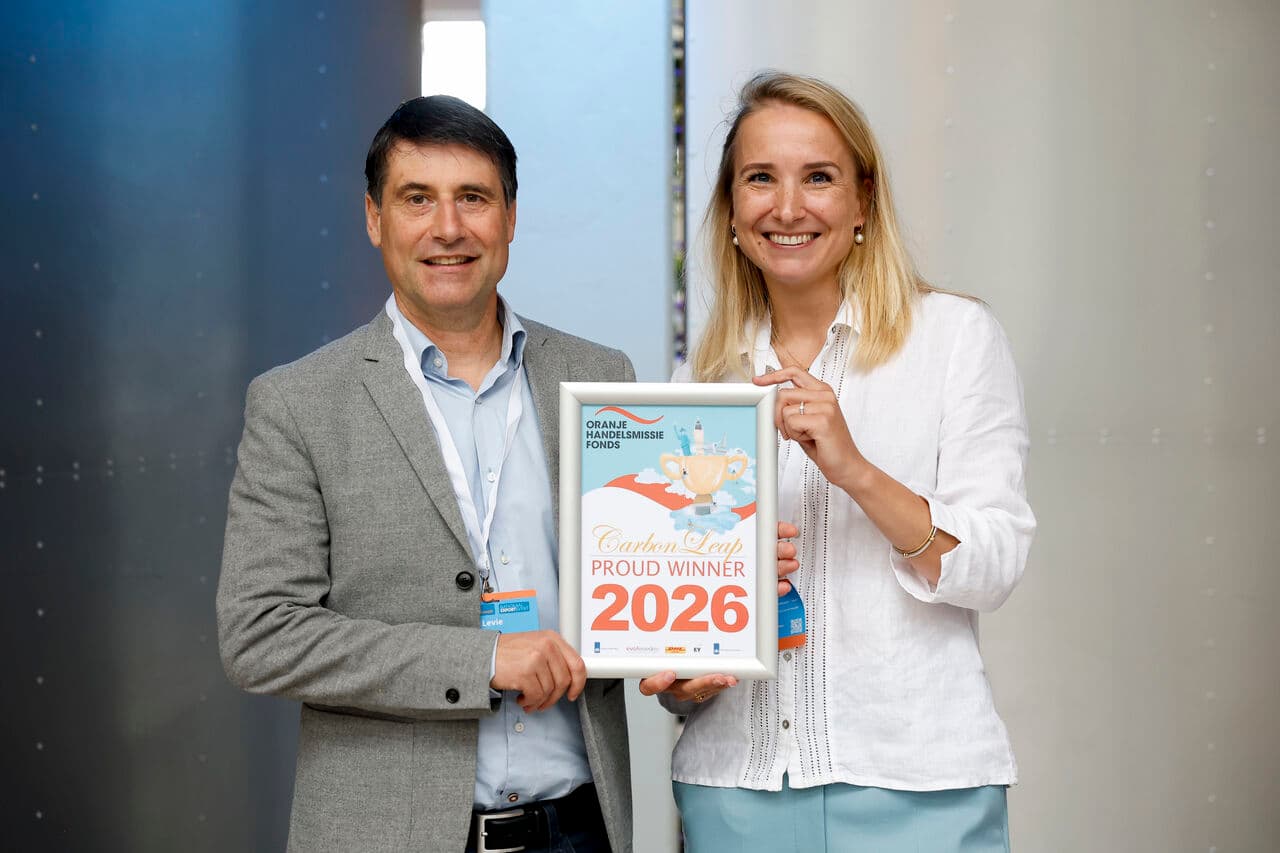
We're one of the 10 winners of the Oranje Handelsmissiefonds 2026! 🏆 The winners were announced yesterday at the Nationaal Export Event in The Hague, selected from more than 200 entries. Each of us got 30 seconds on stage to pitch our company to a room full of exporters and embassy staff, which is not a lot of time to explain Book and Claim. Over the next year, the fund will support us in taking our next step abroad, through a trade mission, the global network of the Ministry of Foreign Affairs, training, coaching and more.
CarbonLeap
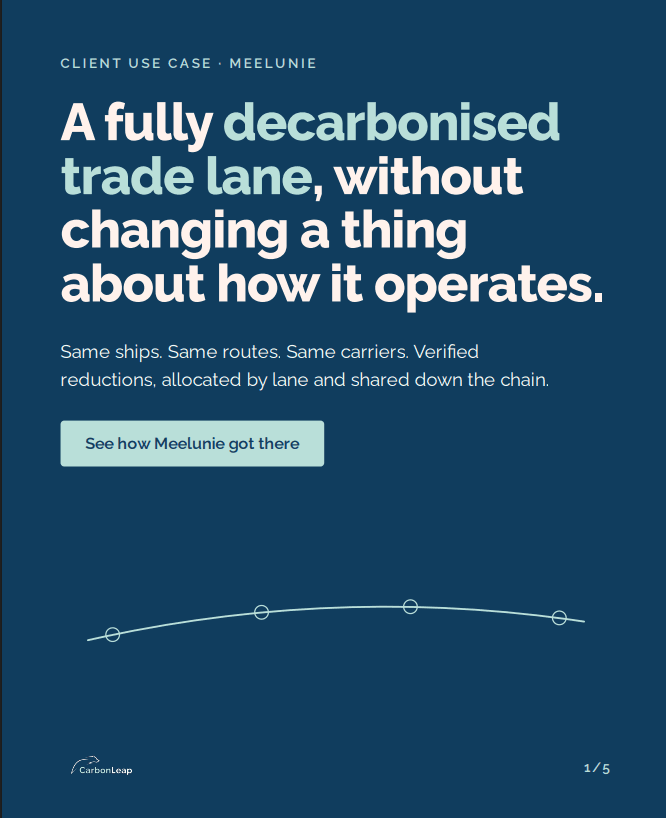
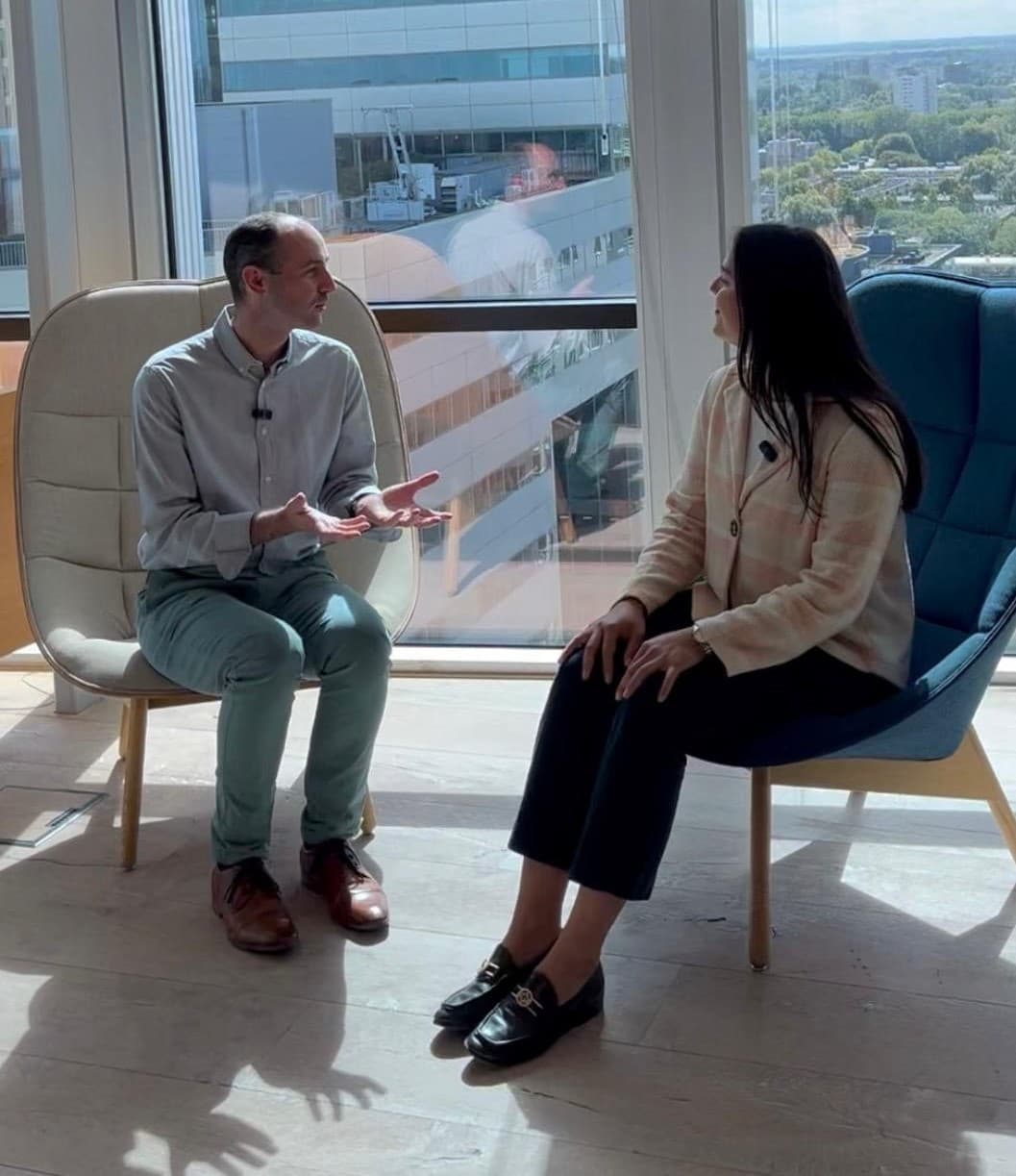
"We use this fuel switch as part of our overall service towards customers, creating a one-stop shop for the customer." That's Jeroen de Waaij, Global Sustainability Manager at Meelunie Meelunie does this with a fuel switch based on Book and Claim. Biofuel made from waste streams replaces fossil fuel in the transport network. The verified reductions are recorded in the CarbonBank, where Meelunie claims them and allocates them to their customers. The carousel shows how they got there, from hitting the ceiling of optimisation to a verified programme their customer chose to extend. The full case study is in the first comment. #Decarbonisation #Logistics #Scope3 #CarbonInsetting
CarbonLeap
Most companies stop decarbonizing when they hit a ceiling. You optimise the routes. You shift what can be shifted to rail and barge. Then you run into infrastructure and availability. Between continents, the intermodal options largely do not exist. Meelunie kept going. They made a fuel switch through carbon insetting. Fossil fuel replaced with second generation biofuel from waste streams, delivered where it can physically happen. Same ships, same routes, same carriers. Meelunie allocated the reductions per trade lane, allocation can also be done per product or per customer. The added value: Meelunie now offers the reductions as part of the service they provide, which is how Jeroen de Waaij, their Global Sustainability Manager, describes it in the video. Their customer's own sustainability advisor reviewed our governance, fuel policy and methodology in full. Afterwards, that customer asked to extend the programme into more modes and more regions, and both companies now co-finance the reductions. If you are building an internal business case for transport decarbonisation, this is useful input. Jeroen tells the story better than we can. Full video below. #Scope3 #Decarbonization #CarbonInsetting #Transportdecarbonization
CarbonLeap
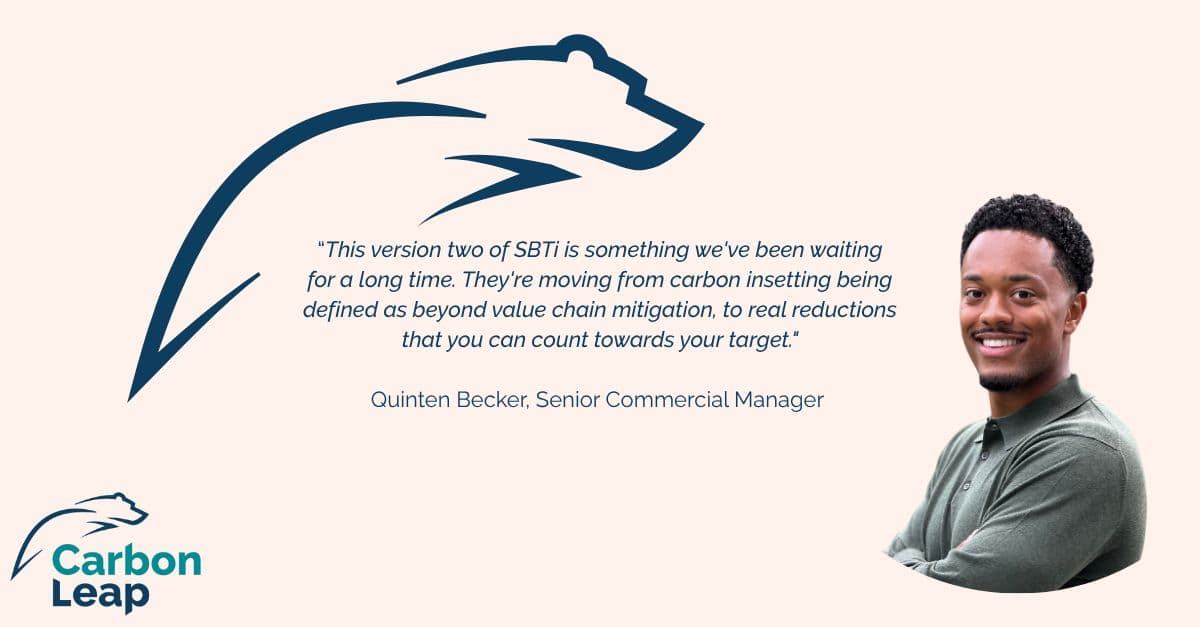
📢 SBTi V2 webinar recap: thank you! We had such a good turnout for our Club Leap webinar on SBTi's Corporate Net-Zero Standard V2.0. A big thank you to all who joined and asked sharp questions! One key takeaway from Quinten Becker, our senior commercial manager: "This version two of SBTi is something we've been waiting for a long time. They're moving from carbon insetting being defined as beyond value chain mitigation, to real reductions that you can count towards your target." Market instruments are now formally recognized as valid target implementation. They're tracked separately from your physical inventory, but they're a credible route to progress. For hard to abate sectors like transport, that's a meaningful unlock. A few other things we covered: - Direct action still comes first: market instruments step in once you hit real bottlenecks (availability, infrastructure, transparency). - Three tiers of insetting (sector, activity-pool, activity-based): the closer the match to your own operations, the higher the tier. - No need to switch carriers or reroute to make it work. Missed it? Become a ClubLeap member and you'll get the recording plus early access to sessions like this one going forward. #TransportDecarbonization #SBTi #CarbonInsetting #Scope3
CarbonLeap
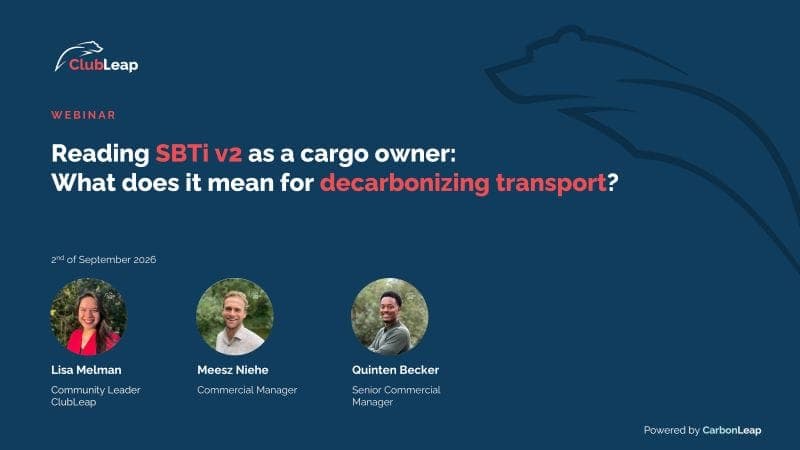
On Wednesday, Lisa Melman Quinten Becker and Meesz Niehe hosted a webinar on SBTi's new Corporate Net Zero Standard v2 and what it means for transport decarbonization. The turnout told us everything: this topic is top of mind for a lot of you right now. These are our key takeaways: ➡️ Carbon insetting, and other market instruments, are now claimable towards your SBTi target under version 2.0. That is a real shift from the previous standard, where these actions sat outside your value chain reporting. Now, when the right integrity criteria are met and the tier hierarchy is followed, they count towards your target. ➡️ All tiers are eligible for claiming towards your target. Tier 1 is the strongest claim you can make, since it sits closest to your own supply chain. At CarbonLeap, our methodology is built to align with exactly these integrity criteria and this tier hierarchy. We take the entire procurement and verification process out of your hands. You set the ambition, we source, negotiate, contract, so you receive a verified claim that fits straight into your reporting. Have you missed our webinar and want the full recording and slides? Sign up for our Clubleap community find it on our community platform. Have a direct question about what this means for your own operations? Reach out, we are happy to talk it through. #TransportDecarbonization #SBTi #MarketInstruments #FuelSwitch
CarbonLeap
📢 Secure your spot now to get straight answers on SBTi V2 #SBTi released its Corporate Net-Zero Standard V2.0. Since then, we've fielded the same three questions on repeat: • Do EACs count toward your SBTi target? • How do you report book-and-claim correctly? • What does this mean for your transport decarbonisation strategy? Join Lisa Melman our ClubLeap community lead, together with commercial managers Meesz Niehe and Quinten Becker, for an exclusive look at how the standard translates into practice. In 30 minutes, we'll break down what's clear, what's still moving, and what to act on now, with live Q&A. 📅 Wednesday Sept 2, 16:00–16:30 CET 📍On our community platform Built for sustainability and procurement leads navigating V2.0. Register below and we'll send you the link. #SBTi #EACs #CarbonInsetting #Scope3 #TransportDecarbonization
CarbonLeap
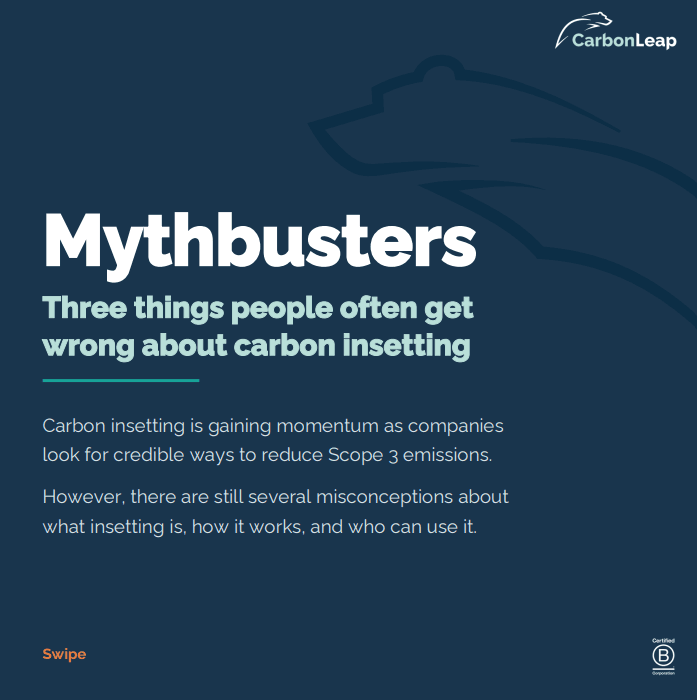
The transition to lower-carbon transport requires more than ambition. It requires practical mechanisms that enable companies to contribute to emissions reductions across complex global supply chains. Carbon insetting is one of those mechanisms. By creating demand for lower-carbon transport solutions within existing value chains, companies can help enable emissions reductions beyond their own direct operations, even when they do not own the assets involved. As interest in carbon insetting grows, we continue to see several questions arise: • How is insetting different from offsetting? • How can emissions reductions be claimed when the fuel is not physically delivered to a specific shipment? • How can businesses influence transport emissions without owning fleets? The answers start with a clear understanding of how emissions reductions within value chains can be supported, measured, and accounted for. Carbon insetting focuses on enabling emissions reductions within the value chain by creating demand for lower-carbon alternatives and supporting the transition of transport systems. Market-based approaches can help connect demand with available lower-carbon solutions across global transport networks, while ensuring that claims and accounting follow robust and transparent frameworks. We explore three common misconceptions about carbon insetting in the carousel below. #CarbonInsetting #Scope3 #Decarbonization #SustainableTransport #SupplyChain
CarbonLeap
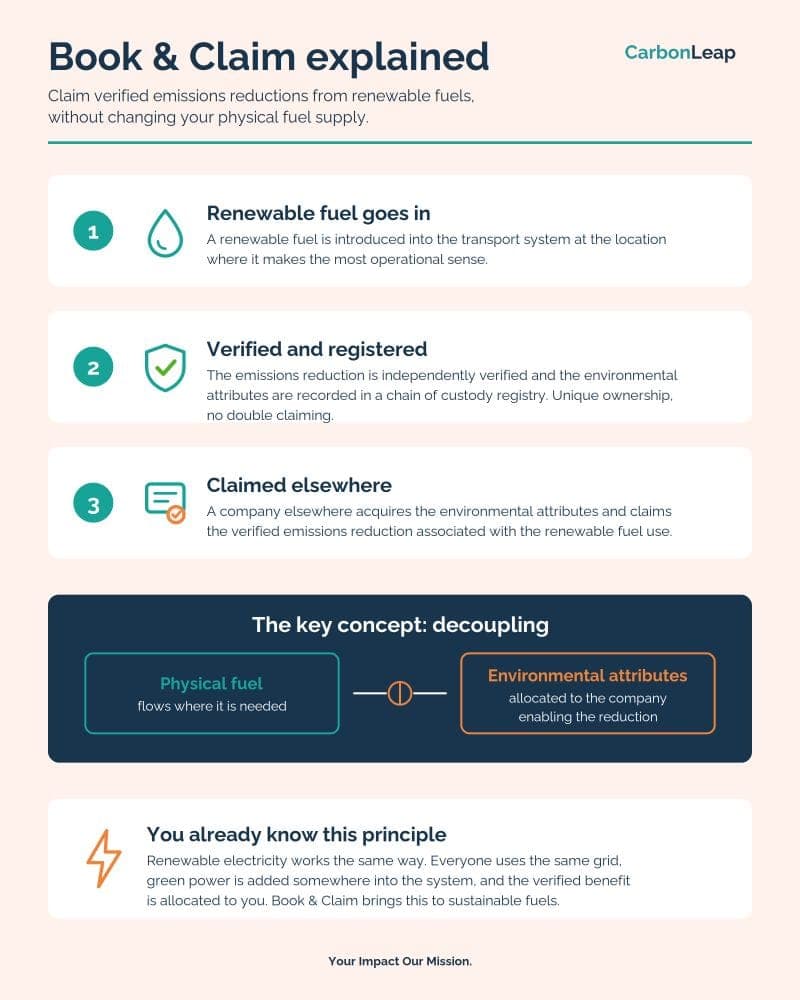
Book & Claim explained Book & Claim is a chain of custody model that enables companies to claim verified environmental benefits from renewable fuels without requiring the physical fuel to be delivered to their specific operations. While the concept may sound complex, the principle is straightforward. The model works in three steps: 1. A renewable fuel is introduced into the transport system at the location where it makes the most operational sense. 2. The associated emissions reduction is independently verified, and the environmental attributes are recorded through a robust chain of custody system, ensuring unique ownership and preventing double claiming. 3.A company elsewhere can acquire these environmental attributes and claim the verified emissions reduction associated with the renewable fuel use. The key concept is the decoupling of the physical fuel from its environmental attributes. This allows renewable fuels to be deployed where they create the greatest operational value, while enabling companies across global supply chains to support and claim verified reductions. Most people already know this principle from renewable electricity. Think of the electricity grid. You use the same grid as everyone else, but renewable energy is added somewhere into the system, and the verified environmental benefit can be allocated to you. Book & Claim applies the same principle to renewable fuels such as SAF and HVO. The physical fuel flows where it is needed, while the verified environmental benefit can be allocated to the company enabling that reduction. By separating physical supply from environmental attributes, Book & Claim creates a scalable way to direct investment into renewable fuels and accelerate emissions reductions across global transport networks.
CarbonLeap
Asset based LSP, but can your own fleet cover all decarbonization demand? In logistics, there are broadly two types of LSPs: asset-based operators who run their own fleet and freight forwarders who solely organise transport through a network of carriers. Today we look at the first group. The advantage is obvious. When a customer asks for real reductions, an asset-based operator is in full control and can put low-emission fuels in their own tanks and act on it directly. If physical execution is within reach, that is always the first choice. We fully support the direct route wherever it works. But in reality, few asset-based LSPs are 100% asset-based. Part of the volume runs through your own fleet, and part through a subcontractor network you do not control yourself. And even on your own lanes, complexity may arise. Sometimes the sustainable fuel is too expensive on a given route. Sometimes it is not available where you need it. Sometimes the volume a customer is asking for goes beyond what your own tanks can deliver and requirements can't be met. That gap, on your own lanes and across your subcontractor network, is where we come in. We pursue the fuel switch on your behalf, across all modalities: road, sea and air, wherever it is most efficient. You claim the Scope 1 reduction, and to meet your customers request we allocate a tailor made certificate to your customer for their Scope 3. All externally verified, all in one place. For asset-based LSPs that means: ✓ Meet every customer's demand, across your own fleet and your subcontractor network ✓ The most cost efficient path when direct fuelling is not feasible ✓ Tailor made certificates, externally verified, end to end across all modalities Own fleet, subcontracted, or both, the question customers are asking is the same: can you deliver claimable real Scope 3 reductions, all the way to net zero. This is how asset-based LSPs answer it without being capped by the size of their own fleet. We have already set up programs with several asset-based freight forwarders, and we would like to see how we can support yours. If interested to explore, get in touch with Quinten Becker 🚀
CarbonLeap
The SBTi just released Corporate Net-Zero Standard V2.0, and it validates what we've been building at CarbonLeap. For the first time, the standard explicitly recognizes book-and-claim as a legitimate solution for companies addressing emissions beyond their direct control. What matters: • The integrity requirements are now formalized: unique attribution, temporal alignment, system-level impact, transparent tracking. These have always been CarbonLeap's standards, where integrity has always been non-negotiable for us. • This creates real opportunities. Companies in transport, food, pharma, FMCG and fashion setting scope 3 targets need high-integrity insetting solutions that combine direct action with credible market instruments. At CarbonLeap, we built exactly this: third-party verified book-and-claim insetting through CarbonBank, with the rigor that V2.0 now formalizes. We're the credible bridge while the system transitions. If you're setting transport decarbonization targets this year, the standard is clear on what works. Ready to move from ambition to credible action? (Full SBTi Corporate Net-Zero Standard V2.0 document linked in comments.) #NetZero #ScienceBasedTargets #Decarbonization #SupplyChain #CarbonInsetting
CarbonLeap
In logistics, the game is changing. We see two types of LSPs: asset-based carriers with their own fleet, and freight forwarders who organise transport through a network of carriers. Both are facing a shift, not just CO₂ reporting, but growing demand for actual reductions. For asset-based carriers, execution is within reach through a fuel switch. For freight forwarders, it is more complex. The responsibility sits with them, while the physical execution lies with the carriers they work with. Route optimisation is often no longer enough, modal shifts are not always feasible, and a physical fuel switch via the carrier is not always efficient. This leaves forwarders caught between rising demand and a toolkit that falls short. We see collaboration with LSPs as the way forward. We help you give your customers what they are increasingly asking for: real Scope 3 reductions, all the way to net zero. For forwarders, this is a direct answer to growing client demand, and it comes with: ✓ No upfront investments ✓ No operational changes ✓ The most efficient and scalable path to sustainable fuel adoption Our conviction: forward-thinking LSPs do not wait for the demand to come in. They actively offer this on their transport lanes. That is how we decarbonize the transport sector together. Curious how other professionals in supply chain decarbonization are thinking about this? Get in touch with Meesz Niehe, our Commercial Manager 🚀
CarbonLeap
The Strait of Hormuz just stress-tested every Scope 3 transport decarbonization strategy. Most failed. Find out why 👇 Since tensions in the region escalated, fossil prices have spiked on the back of Middle East risk, OPEC discipline and shifting trade flows. For example, jet fuel moved sharply. SAF moved too, but slower, causing the SAF premium over jet fuel to narrow in the same window. The headline reads: the green premium is narrowing, but less companies are moving What we hear from the market: "We will revisit when prices normalize." Programs paused, RFPs delayed, decisions pushed to next quarter. What we hear from the corporates actually executing: the opposite. They are locking in volumes now, precisely because they refuse to let oil price sentiment dictate their 2030 trajectory. Which exposes the deeper issue: too many Scope 3 plans are still indexed to company margin. When fossil is cheap, there is budget. When fossil spikes, the climate plan slips a year because "now is not the right time." That logic is backwards. 🔙 The corporates that will land their 2030 targets are the ones that have decoupled their climate plan from oil price sentiment, and are treating decarbonization as infrastructure, not as a sustainability marketing budget. Volatility is not a reason to wait. The opportunity that arises today, will not be available in 2028. At CarbonLeap, we are not pitching the waiters. We are scaling with the movers.
CarbonLeap
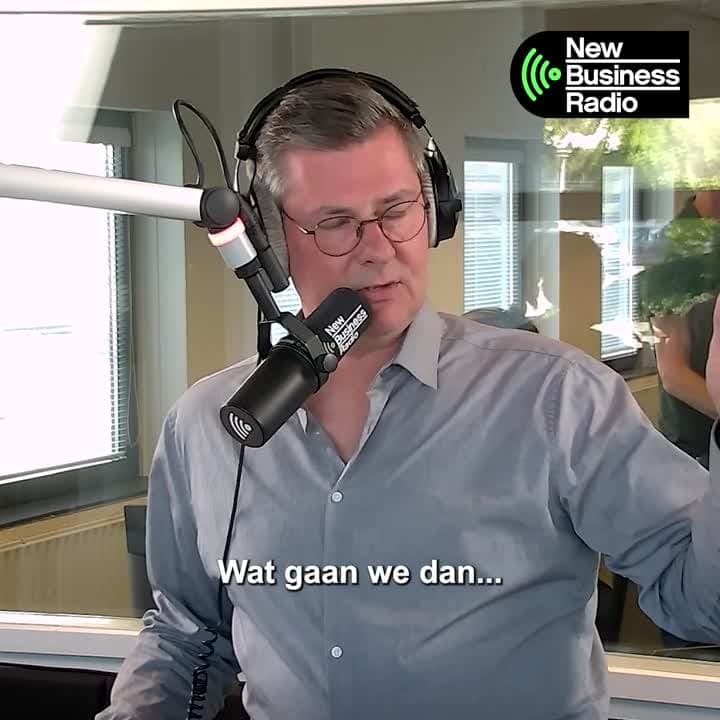
Real emission reduction. No operational disruption. That is the promise of carbon insetting. As our colleague Lisa Melman explained on New Business Radio last week, you can credibly reduce your Scope 3 transport emissions without changing a single operational detail: same carriers, same (fuel)contracts, same routes. Here’s how it works: 🚛 What we do: We enable verified fuel switches in transport (road, air, marine, rail) and allocate the verified emissions reductions directly to your Scope 3 using a Book and Claim approach. Real fuel, real reduction, real impact today. ⚙️ How we do it: We source verified fuel switches from partners, independently verify each reduction, allocate them through our CarbonBank platform, and track everything transparently. You focus on operations, we manage your Scope 3 transport decarbonization. ✅ Why it holds up: every reduction is transparent, fully traceable, independently verified, and audit-ready for your reporting. Curious how this could work for your supply chain? Get in touch, we are always happy to talk! #SupplyChainDecarbonization #Scope3 #CarbonInsetting #TransportEmissions
CarbonLeap
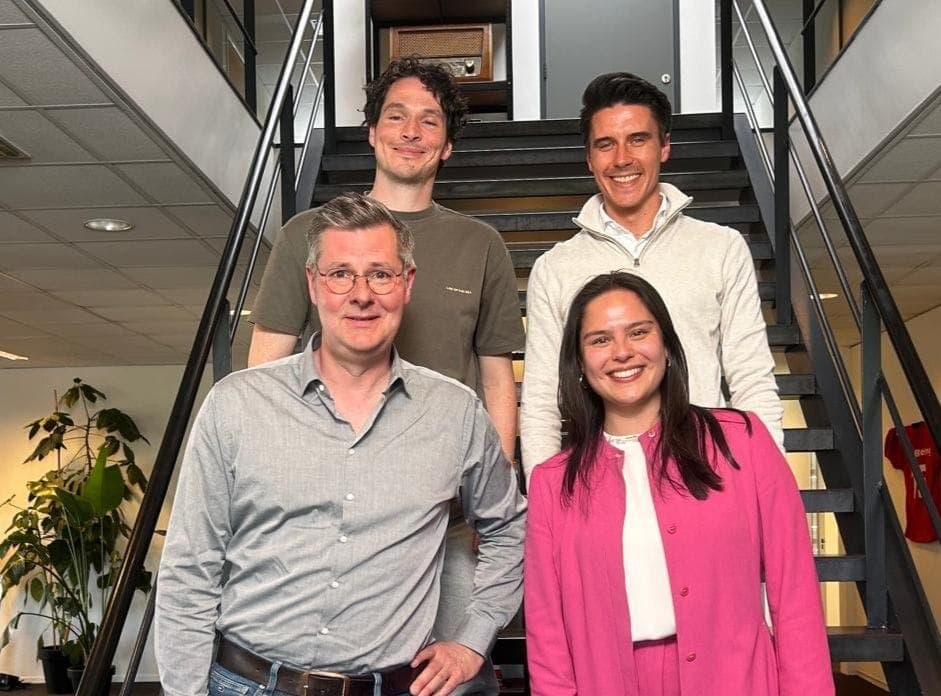
The energy transition in transport is being made unnecessarily expensive, and unnecessarily slow. Last week our colleague Lisa Melman was on New Business Radio to talk about what is actually holding the transport sector back in decarbonization, and what it takes to get moving. A few moments from the conversation: "The question is not whether transport will become more sustainable. The question is when, and whether you are ahead of that shift, or behind it." The barrier is not motivation. It is not technology. It is a market stuck in its own logic, where everyone is waiting for someone else to move first. "Fuel producers wait for demand. Companies wait for supply. That is the deadlock holding the whole sector back. What we do is break it: we get companies moving now, which reduces emissions today and pushes the market forward at the same time." This is exactly why CarbonLeap exists. We work with companies that refuse to wait, helping them act now through verified carbon insetting. Real emission reductions today. Real momentum for the cleaner fuel market at the same time. The companies that move first are not just reducing their own emissions. They are shaping what the rest of the sector will be able to do tomorrow. Thanks to Glenn van der Burg, Daniel Lippens, Nick van Vuren, and New Business Radio Joep Maigret Jaco Bal for making space for this conversation! 🎙️ Full conversation in the comments. #SupplyChainDecarbonization #Scope3 #Scope1 #CarbonInsetting #EnergyTransition
CarbonLeap
Picture this: a company has been working on their sustainability strategy for three years. Smart people, good intentions, genuine drive. Yet somehow, still in the assessment phase. The business case goes to the board, comes back with more questions, gets revised and goes back again. The decision keeps getting postponed: one quarter it is the market conditions, the next a framework that has not been finalized, the next a leadership change that puts everything on hold. We get it, decarbonization decisions carry real weight. Financial consequences, reputational stakes, long term commitments that are hard to reverse... The pressure to get it right is genuine, and so is the fear of getting it wrong. But waiting has a cost too. One that rarely shows up on a spreadsheet, but shows up everywhere else. In the emissions that did not have to happen, in the momentum that never quite built, in the transition that keeps getting described as urgent while the decisions keep getting postponed. We challenge the status quo. We don't accept slow progress or wait for perfect conditions. We choose progress over comfort. If your company is struggling with that same question of when to move and how, ClubLeap is your space. A free community for companies navigating supply chain decarbonization, where honest conversations happen and nobody has to figure it out alone. Link in comments 👇
CarbonLeap
Coming out of #SmartFreightWeek2026, one thing is clearer than ever: the industry knows what needs to happen. The question is whether we'll move fast enough. Three days at #SmartFreightWeek2026 reinforced something we've been seeing across our conversations with shippers and carriers: the gap between knowing and acting. On Book & Claim, we're seeing real progress. The conversations have shifted from "what is B&C?" to "when does it create real impact?" That's progress. But there's still this reflex to wait for every framework to align before acting. Companies freeze their plans waiting for standards bodies to provide clarity on market-based measures. Every month of delay gives laggards another excuse. What really stood out for us: We need to talk about sustainable solution security. Waiting for clean alternatives to magically get cheaper won't get anyone to their 2030 goals. The tools exist today. Market-based measures are gaining momentum. Credibility and transparency aren't nice-to-haves anymore, they're the foundation. We're seeing B&C emerge for BEVs as a way to share investment costs and lower TCO. That could reshape electrification economics. Our takeaway? The companies that will succeed aren't waiting for perfect conditions. They're acting on good enough conditions, with credible processes and transparent partners. Because the molecules being burned today won't wait for a perfect standard tomorrow. #SmartFreightWeek #BookAndClaim #Decarbonization #TransportDecarbonization
CarbonLeap
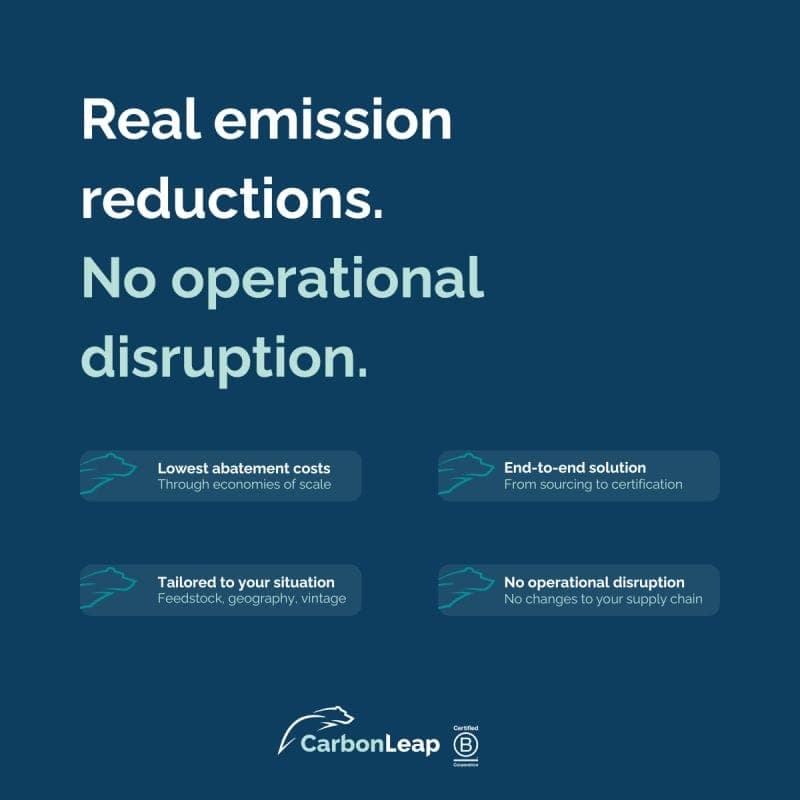
Real emission reductions. No operational disruption. At CarbonLeap, we make carbon insetting practical and accessible. Here is what we bring to the table: ◆ Lowest abatement costs through economies of scale ◆ Tailored to your situation on feedstock, geography and vintage ◆ End-to-end solution from sourcing to certification ◆ No operational disruption and no changes to your supply chain needed Come find us at the Tool & Innovation Fair at Smart Freight Week next week. Let's talk about what insetting looks like for your supply chain. 🚀 📍 De Kromhouthal, Amsterdam · 14–16 April Smart Freight Centre #SmartFreightWeek #MarketBasedMeasures #CarbonInsetting #Scope3 #SupplyChainDecarbonization
CarbonLeap
THIS IS CLUBLEAP — 01 We level the playing field. Something is happening in the energy transition that we need to talk about. The playing field is not equal. Some companies have dedicated teams, resources and networks to find their way through supply chain decarbonization. Many others are navigating the same challenges with far less to work with, and are expected to get to the same place. Your Scope 3 is someone else's Scope 1. The transition only works when companies of all sizes and at every level in the supply chain can take part. Scope 3 is a shared responsibility. That is what we believe. Every company deserves a real path forward. Regardless of size or transport volume. Nobody has a perfect map yet. But we can give you a compass, a next step, and a community of people navigating the same journey. That is why #ClubLeap exists. Come join us 🚀 → https://lnkd.in/eUTTW3m5
CarbonLeap
The LSP solution to green freight When cargo owners want to cut emissions, who do they turn to first? Often, it's their logistics partner. That's why we not only work with cargo owners directly, but also have a dedicated insetting program with logistics service providers. Because the more accessible we make insetting, the more freight actually goes green. For LSPs though, delivering on that promise is easier said than done. Multiple lanes, fuel contracts, and assets they don't own themselves create friction at every step. That's exactly what led us to build our program. One centralised place to decide which, when and where low-carbon fuels are used, giving full transparency and control, backed by trusted Carbon Abatement Statements. Easily incorporated in existing systems, LSPs can respond to any customer request with no upfront investment and no operational headaches. Decarbonization is increasingly part of the freight conversation. And we're not precious about the route, we just want the right solution to land at the end-user, delivering the most impact per euro. Curious how this works? Visit our website or reach out to Meesz Niehe. #GreenFreight #Sustainability #LSP #FreightDecarbonization #CarbonReduction #CarbonInsetting #BangForBuck
CarbonLeap
The ClubLeap community platform is live! 🚀 A dedicated private space for members to stay informed, explore options, connect with others on the same journey, and access exclusive opportunities around supply chain decarbonization. All in one place, at your own pace. On day one, there's already something worth opening it for. We've taken years of experience working with companies on supply chain decarbonization and distilled it into one cornerstone piece: the Supply Chain Decarbonization Map. A practical overview of the full journey, from understanding your footprint to taking real action. Every company is at a different stage. Every route looks a little different. But there is a logic to it, and we've mapped it out so you can see where you are, what makes sense next, and what to keep in mind further down the road. This is the kind of clarity we believe should be open and accessible to everyone. Because the more companies that can find their way, the faster we all move. ClubLeap is free. The map is inside. Come take a look. 🚀 👉 https://lnkd.in/eUTTW3m5 #SupplyChainDecarbonization #Scope3 #ClubLeap #Logistics #Sustainability
CarbonLeap
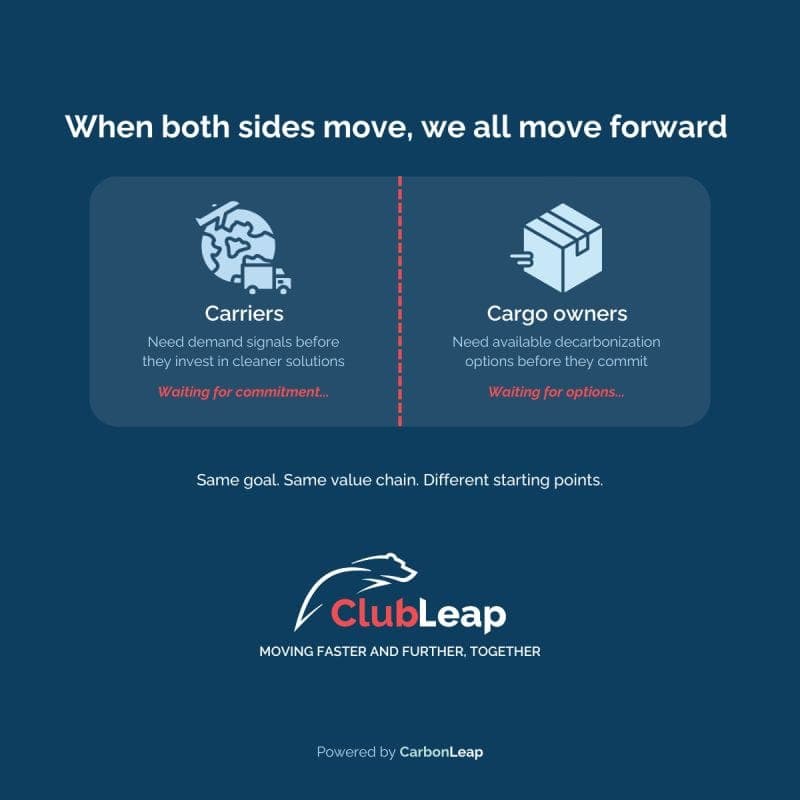
The targets are set. 2030 is closer than it feels. But supply chains still need to run. Costs need managing. Operations can't pause. A system change is needed, and while steps are being taken, it won't happen overnight. So: "what can we do now, within the reality we're operating in?" Here's what we keep seeing. Carriers and cargo owners want the same thing: a more sustainable supply chain. But they're stuck in a classic chicken-and-egg dilemma. Carriers need demand signals before they invest in cleaner solutions. Cargo owners need available options at a fair price before they commit. The ambition is there, on both sides. What's often missing is the bridge between them. We believe both sides need to move. That's what we're here to help facilitate. #ClubLeap brings companies together to learn, find direction, and take action on supply chain decarbonization. Same goal. Same chain. Join the community and let's move together → https://lnkd.in/eUTTW3m5 #Scope3 #SupplyChainDecarbonization #EnergyTransition #Logistics
CarbonLeap
Voluntary Carbon Markets Are Becoming Execution-Driven and Supply Chains Are Taking Notice 2025 data shows voluntary carbon markets are becoming execution-driven. This is not about hype or market size, but about how capital, credibility, and decarbonization are being applied in practice. Early 2026 trends suggest this shift is continuing. At CarbonLeap, we see several patterns: 💡Capital is moving toward integration, not stand-alone offsets The global voluntary carbon market was estimated at around $2.5 billion in 2025 and is projected to grow to roughly $3.0 billion in 2026, illustrating continued market expansion as companies focus more on execution‑driven decarbonization approaches such as insetting (Global Growth Insights, Feb 2026) 💡 Scope 3 is driving demand Over 90% of companies currently buying carbon credits plan to continue, with many anticipating volume increases over time. Future buyers are more sensitive to pricing and regulation, particularly across different regions (Morgan Stanley Institute for Sustainable Investing, How Companies Are Approaching Voluntary Carbon Credits, Jan 2026). 💡Carbon is moving from compliance to operational strategy Most companies expect the majority of their emissions reductions to come from projects within their own operations or supply chains, with offsets used only for residual emissions. (Morgan Stanley Institute for Sustainable Investing, How Companies Are Approaching Voluntary Carbon Credits, Jan 2026). 💡High-integrity and long-term planning matter The market is increasingly prioritizing high-quality, verifiable credits, supported by integrity frameworks and independent ratings. Companies are focusing on measurable, outcome-driven approaches, signaling a maturing, execution-driven market (Climate Impact Partners, Market Outlook 2026). Bottom line: Voluntary carbon markets are maturing into true infrastructure for decarbonization, not a shortcut around it. For companies tackling Scope 3 emissions and complex supply chains, this evolution unlocks credible, long-term impact. #VoluntaryCarbonMarkets #Decarbonization #SustainableSupplyChains #Scope3Emissions
CarbonLeap
Most companies aren't struggling with wanting to decarbonise their supply chain. They're struggling with how. There's no shortage of solutions, standards, and frameworks out there. But figuring out what applies to your situation, what's credible, and where to start? That's where it gets hard. Especially without a large sustainability team. That's exactly why ClubLeap exists. ClubLeap is a community for companies navigating supply chain decarbonisation, powered by CarbonLeap. We keep you ahead of the curve, help you navigate the complexity and enable collective action. No company has to figure this out alone. Join a community where companies learn, collaborate, and move forward together. See what ClubLeap can do for you 👇 Questions? Reach out to Lisa Melman. Want to join? Link in the comments. #ClubLeap #CarbonLeap #SupplyChainDecarbonization #Scope3 #SustainableLogistics #CollectiveAction
Don't just stare, take the leap! Get in touch with CarbonLeap and start your journey towards a net-zero supply chain.
